What We Build
Custom Pool DecksHow We Build Them
A pool deck takes more punishment than any other surface on the property: standing water, pool chemicals, bare feet and a Cape Cod winter on top of it all. Most of the decks we are asked to replace failed underneath, not on top. Here is exactly how we build one, step by step, so you know what to look for whoever you hire.
Get a Free Estimate- 5-Star Rated on Google
- Licensed & Insured in MA
- 3D Design Before We Build
- All 15 Cape Cod Towns
Step 1
Design around the pool, not just beside it
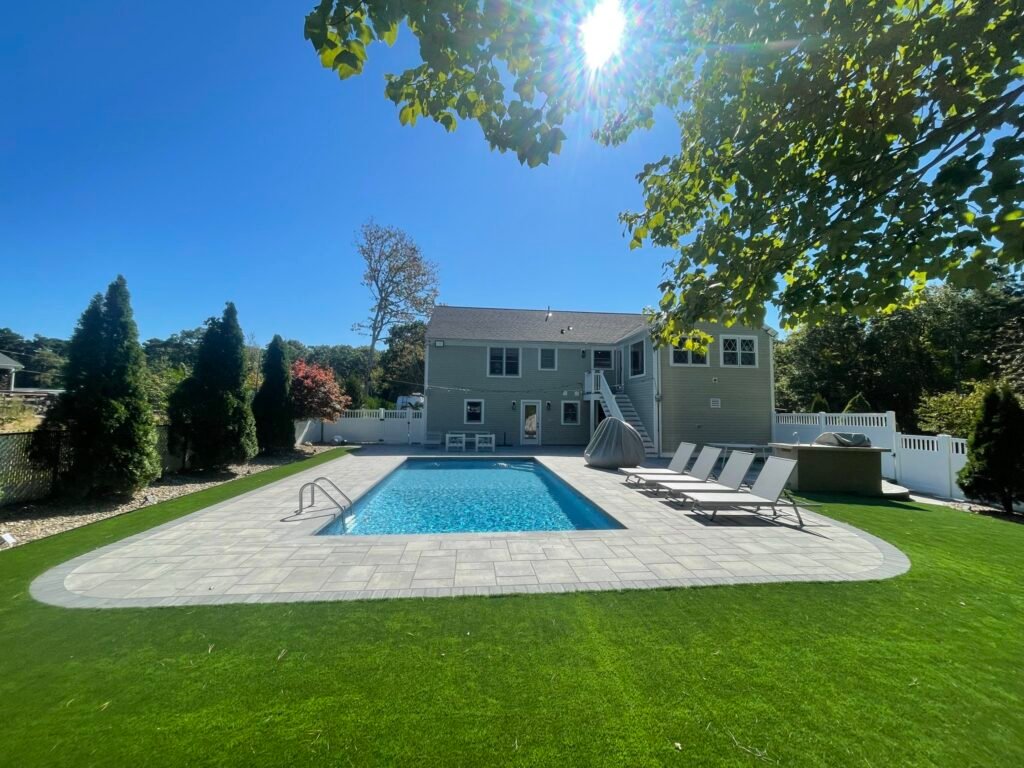
We walk the property first. Where the sun sits in the afternoon, where people will actually set their chairs, how the deck connects to the house, the gate and the outdoor shower. Then we produce a custom 3D design of the finished pool deck in your own yard.
You approve the layout, the stone and the coping detail before a shovel touches the ground. Changing your mind on a screen costs nothing. Changing it after the stone is set costs a great deal.
Step 2
Excavate eight inches
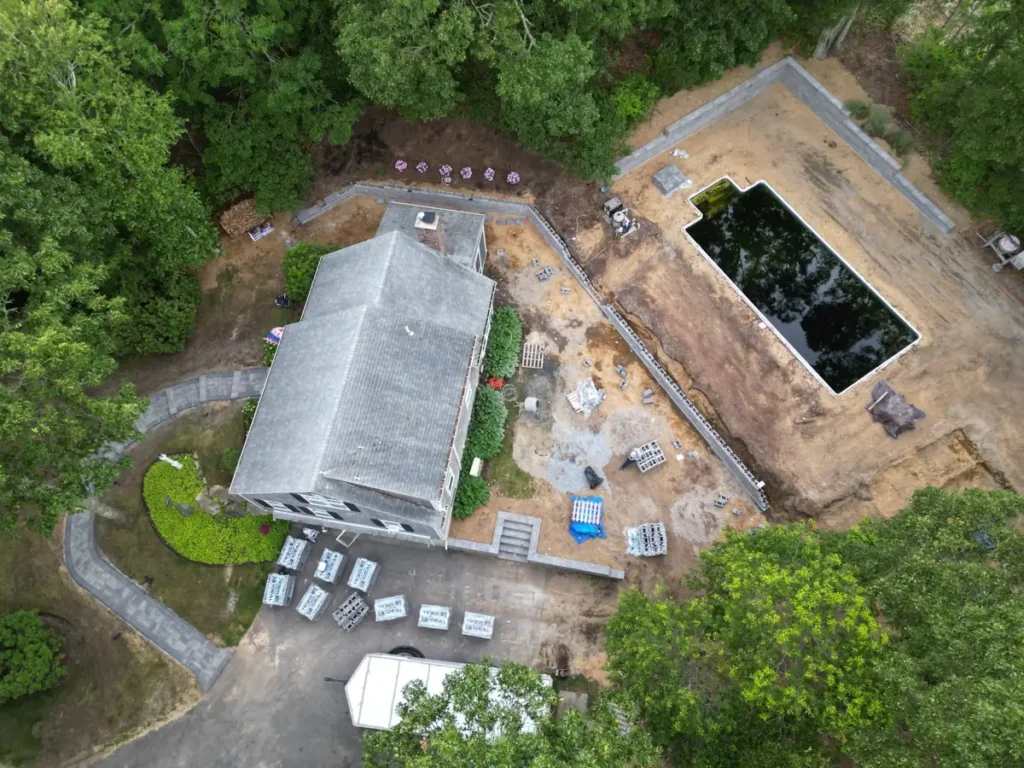
We dig out a full eight inches below finished grade all the way around the pool. Every bit of topsoil and organic material comes out, because organic material decomposes and anything sitting on it drops with it, and a low spot next to a pool holds water.
We over-excavate past the finished edge on every side. That margin is what supports the perimeter, and the perimeter is where pool decks fail first.
Step 3
Four inches of crushed concrete
Four inches of crushed concrete, compacted. Most crews use plain gravel here. We use crushed concrete because the angular pieces lock together and the leftover cement in it re-binds as it is compacted, so it sets up harder and holds that compaction better than loose stone does.
This is the layer nobody ever sees and the one that decides whether the deck is still flat and safe in ten years.
We build the pitch in here as well. A pool deck needs to shed water away from the pool and away from the house, roughly a quarter inch per foot. Water that runs back into the pool carries dirt and lawn treatment with it, and water that sits on the deck turns slippery.
Step 4
Two inches of masonry sand
Two inches of masonry sand goes down, then gets screeded flat. The stone sets into this layer, and it is what lets us hold a true surface across the whole field rather than following every small variation in the base below.
Step 5
Set the coping, then the field
Coping goes first. It is the edge everyone sits on, grabs and steps over, so it is set level and tight to the pool before the field begins, with a smooth edge where skin meets stone.
The field is laid from a straight reference line rather than from the house, because houses are rarely square and the eye reads the pattern. Cuts happen at the perimeter, never in the middle, and no cut piece ends up smaller than half a stone. Small slivers work loose, and around a pool a loose stone is a trip hazard.
Step 6
Polymeric sand and wash
Polymeric sand swept into every joint, then washed and activated with water. It locks the stones to each other, resists weeds and stops ants tunnelling the joints out from below.
The wash matters as much as the sand. Polymeric residue left on the surface hazes the stone permanently, so the pool deck gets cleaned properly before we call it done.
Step 7
Clean-up and handover
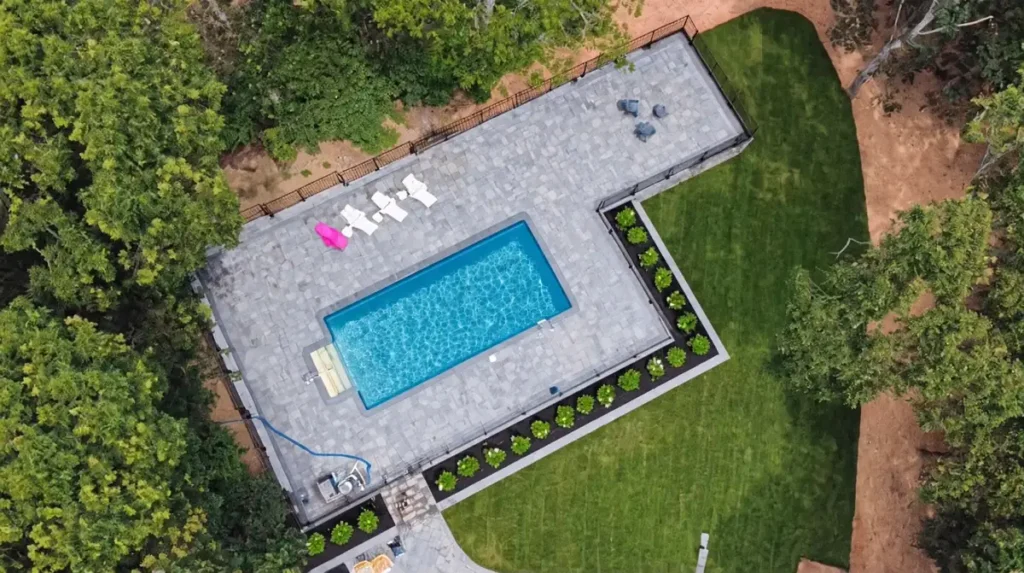
We backfill the edges, bring in loam and seed where we disturbed grass, and take the debris with us. The deck gets a final wash so the first swim happens on a finished surface, not on a job site.
Before and after — drag the handle ↔

 BeforeAfter
Materials
What we build in
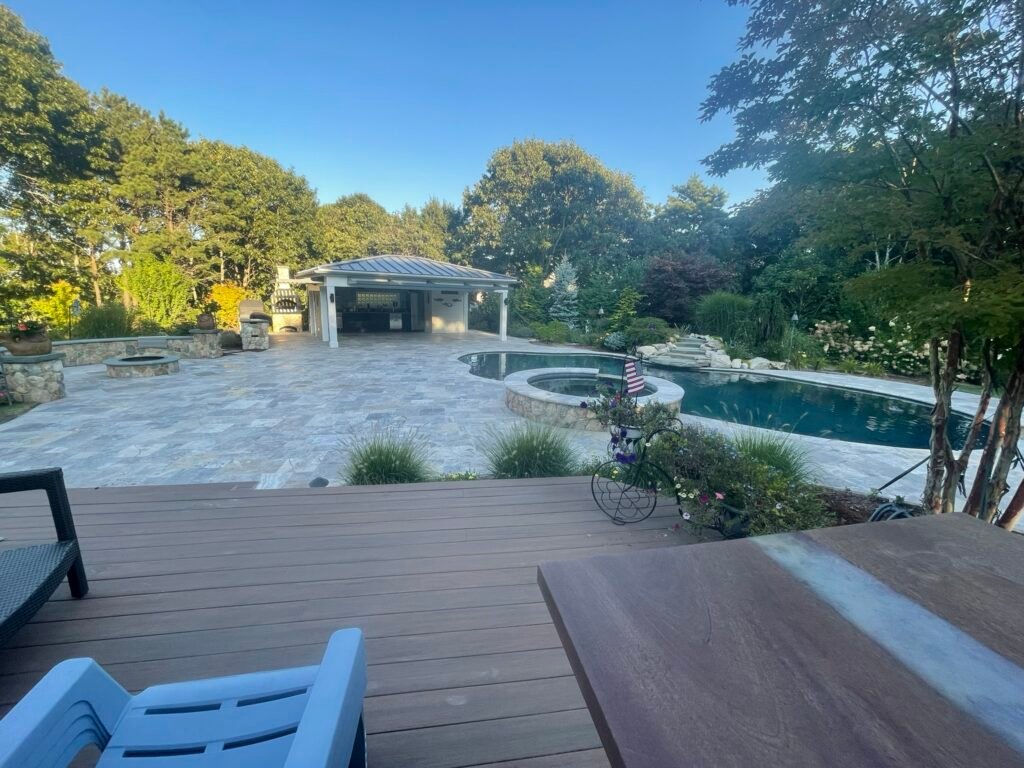
Around a pool we steer toward textured, slip-resistant surfaces and toward stone that stays cool in the sun. Near salt water we choose denser material, because salt breaks down soft stone faster than inland weather does. If the stone you like is wrong for a wet, barefoot surface, we will say so before you buy it.
Ask any contractor
Four questions worth asking
Whoever you hire, these four answers tell you most of what you need to know:
How deep will you excavate?
We go eight inches. Anything materially less than that on Cape Cod sand is optimistic. Ask what happens to the topsoil too, because it all has to come out.
What material goes in for the base, and how thick?
We use four inches of crushed concrete, compacted. Plain gravel works, but crushed concrete locks up and re-binds as it compacts and holds that compaction longer.
What edge restraint do you use, and what is it fastened into?
It should be spiked into the compacted base. Spiked into soil, it moves with the soil.
What is the pitch, and where does the water go?
There should be a specific answer, and it should not be back into the pool or toward your foundation.
Get in touch
Free pool deck estimate
No commitment. We will respond within 24 hours and schedule a visit to your property within 48.
Get a Free EstimateMain: (508) 360-2151 · Office: (508) 373-3495
Masonry and hardscaping contractor serving all of Cape Cod, Massachusetts. Licensed and insured in MA.
(508) 360-2151(508) 373-3495contact@bridimasonryservices.comWhat We Build
- Custom Patios
- Pool Decks
- Walkways
- Stone Steps & Stairs
- Retaining Walls
- Cobblestone Aprons
- Paver Driveways
- Chimney Repair