
Bridi Blog · Masonry Tips
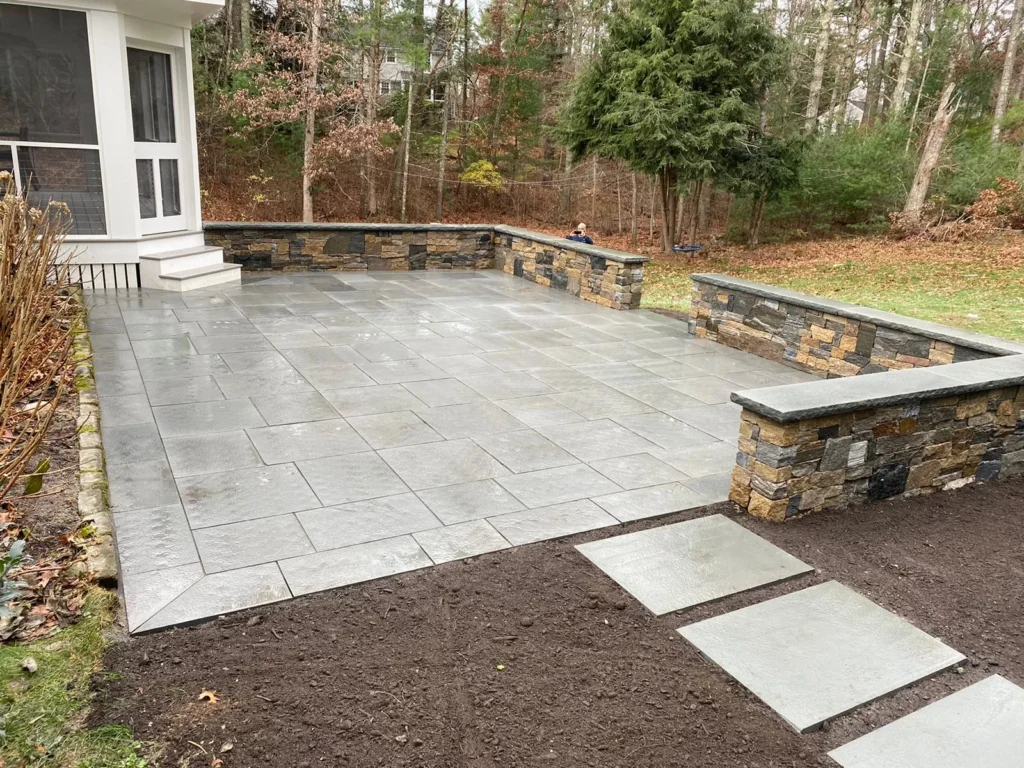
“How much does a patio cost?” is the first question almost every Cape Cod homeowner asks us, and it is a fair one. The honest answer is that two patios of the same size can be priced very differently, and most of the difference is in things you will never see once the job is done. Here is what actually moves the price, so you can compare estimates with your eyes open.
1. Size and shape
Square footage is the starting point, but shape matters almost as much. A simple rectangle against the back of the house goes quickly. Curves, multiple levels, cut-ins around trees and odd angles mean more cutting, more waste and more labor per square foot. If budget is tight, a clean shape is one of the easiest places to save.
2. The material you choose
Concrete pavers, bluestone, travertine, granite and brick all cost differently to buy and to install. Pavers are usually the most budget-friendly of the popular choices. Natural stone costs more, both because the material costs more and because each piece has to be fitted by hand. We compare the options side by side in Bluestone vs. Pavers vs. Travertine.
3. The base underneath (the part nobody sees)
This is where estimates really split apart. A patio is only as level as what it sits on. Our patios start with eight inches of excavation, then four inches of compacted crushed concrete, then two inches of masonry sand screeded flat, and only then the paver or stone, finished with polymeric sand in every joint.
A cheaper estimate often means a thinner base, plain gravel instead of crushed concrete, or no real compaction. It looks the same on the day it is finished. It looks very different after two or three Cape Cod winters, when the low spots and heaved edges show up. When you compare quotes, ask each contractor exactly how deep they dig and what goes under the stone.
4. Your yard: access, slope and what has to come out
- Access. If a machine can drive straight to the work area, the job moves faster. Tight side yards, fences and gates mean more hand work.
- Slope. A flat yard is the simplest. A sloped yard may need a retaining wall or steps to create a level patio, and that is a project of its own.
- Removal. Tearing out an old patio, deck, concrete slab or stumps adds labor and disposal.
- Water. If water already sits where the patio is going, it has to be solved first with grading or drainage.
5. What you add to it
Most patios grow once people see the design. Seat walls, a fire pit or outdoor kitchen, a stone fireplace, steps down to the lawn and low-voltage LED lighting all add to the cost, and they are also what turn a patio into the place everyone ends up. It is cheaper to plan them now than to add them later, especially lighting wire and gas lines that need to run under the stone.
6. Design before you dig
Every Bridi patio starts with a custom 3D design of the finished space in your own yard. You see the size, the stone and the details before anything is dug, which is the cheapest moment to change your mind.
Questions to ask any patio contractor
- How deep do you excavate, and what is the base made of?
- Is the base compacted, and in how many layers?
- What holds the edges in place?
- Where will the water go?
- Will I see a design before you start?
Get a real number for your yard
The only accurate price is one built on your yard, your stone and your plans. We come out, measure, talk through options and show you a 3D design, with no commitment. See how we build on our Custom Patios page, or call (508) 360-2151 for a free estimate anywhere on Cape Cod or in Plymouth County.
Free estimate on Cape Cod and Plymouth County
We come out, measure, talk through options and show you a 3D design before anything is built. No commitment.
Call (508) 360-2151Fill out the estimate form →